
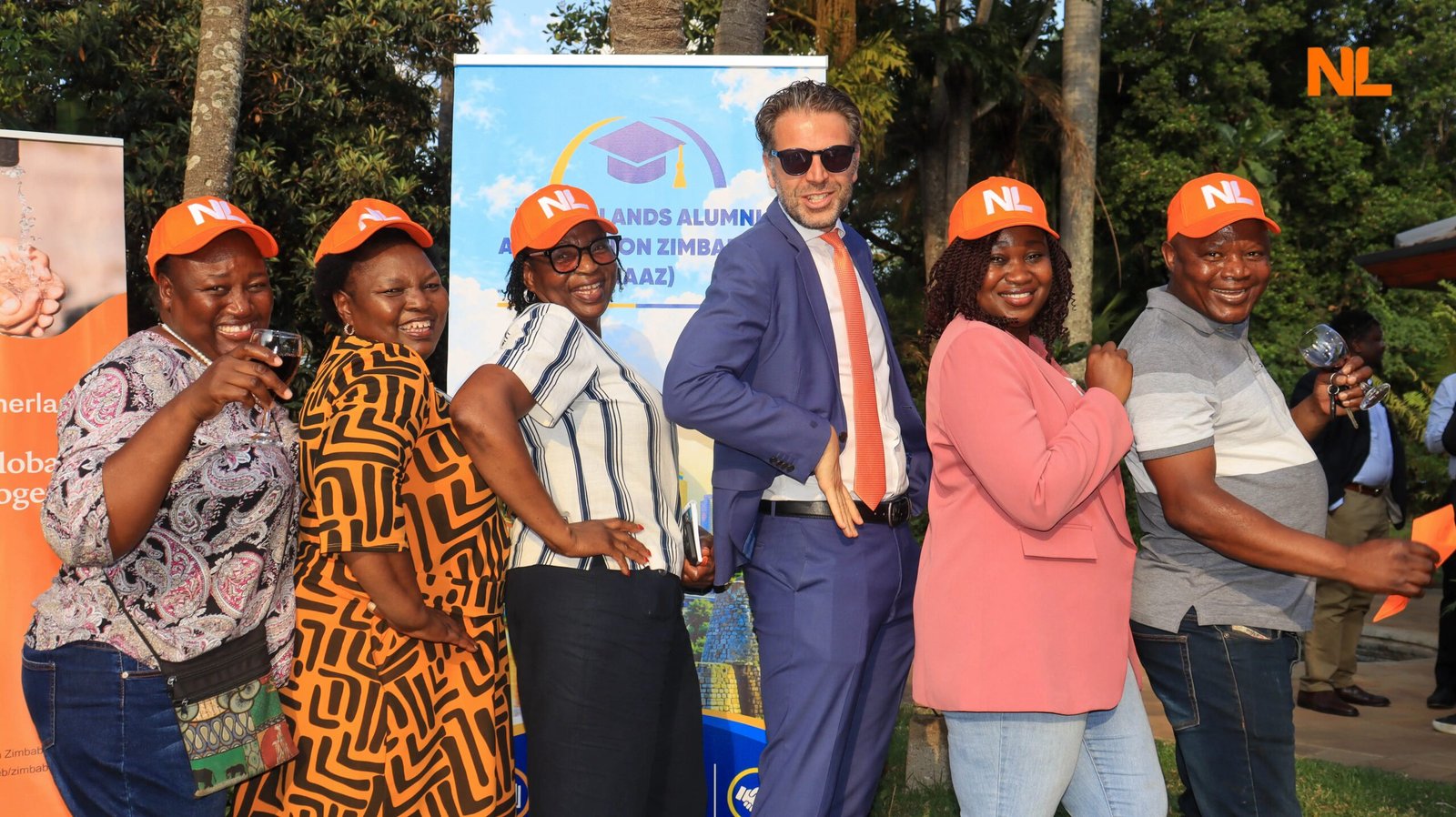
Nearly 1,000 Zimbabweans have studied in the Netherlands over the past decades, with many returning home to apply their expertise in agriculture, journalism, healthcare and development, as educational exchange continues to strengthen professional ties between the two countries.
The contribution of these graduates is now coming into focus as the Netherlands Alumni Association of Zimbabwe (NAAZ) seeks to reconnect former students and build a network capable of translating individual achievements into broader collaboration, innovation and national development.
From helping smallholder farmers develop competitive dairy value chains to equipping journalists with digital storytelling skills and advancing more inclusive approaches to development, their experiences demonstrate how international education can deliver lasting value beyond the classroom.
Ambassador of the Netherlands to Zimbabwe, Matthijs van Eeuwen, said the alumni had become important links between the two countries, contributing to their communities and institutions while maintaining connections with the Netherlands.
“They are not only our friends, but they are ambassadors. They are bridge builders for the Netherlands,” van Eeuwen said.
The experiences of the graduates offer a practical account of how educational opportunities can shape careers, strengthen institutions and support Zimbabwe’s development priorities, while giving renewed purpose to a relationship built through people-to-people connections.
For Dawson Sango, a food security and digital agriculture expert working with the United Nations Food and Agriculture Organisation (FAO), a short course in the Netherlands helped shape a career in international development.
Sango travelled to the country in 2010 to study food security monitoring, at a time when he was building his expertise in monitoring and evaluation.
The training contributed to his professional growth and was followed by more than seven years working for the Netherlands Development Organisation (SNV), before he moved on to other organisations.
“I would really say try the Netherlands, and you will not get it wrong,” he said, encouraging prospective students interested in agriculture and the natural sciences to consider the country.
His experience illustrates the potential of specialised training to strengthen expertise in sectors central to Zimbabwe’s development priorities. In agriculture, where livelihoods and food security depend on increasingly complex production systems, international exposure can equip professionals with additional tools to address local challenges.
For Sango, the opportunity was not simply about studying overseas. It was about acquiring knowledge that continued to open professional doors and inform his work.
Tendai Clementine Maricha, Secretary-General of the Dairy Processors Association of Zimbabwe, experienced the practical benefits of international training while working as an agricultural extension officer in Mount Darwin.
She first travelled to the Netherlands in 2001 for training in dairy husbandry and milk processing, gaining practical skills in herd management, milk production and processing.
Maricha applied that knowledge in supporting farmers to improve milk quality and competitiveness. She said the work contributed to the development of a small-scale milk-processing plant where farmers could aggregate their milk and participate in collective marketing.
In 2008, she returned to the Netherlands to study Agricultural Production Chain Management, specialising in livestock value chains.
The programme strengthened her ability to analyse production systems and develop strategies for improving their performance.
Her journey demonstrates how international education can produce benefits beyond the individual graduate. When technical knowledge is applied through farmer organisations and local production systems, it can help connect small-scale producers to processing and markets.
For Zimbabwe’s agricultural sector, stronger value chains can help producers improve product quality, access markets and increase the commercial value of their output.
Portia Makunde, a livestock and value chain specialist, similarly credits her studies in Management of Development at Van Hall Larenstein University of Applied Sciences with strengthening her professional capabilities.
Her subsequent experience has spanned the public sector, private enterprise and development organisations, including Nestlé Zimbabwe.
Makunde said the programme strengthened her confidence, presentation skills and understanding of gender inclusion, youth participation and livelihoods.
“It improved how I’ve been working in Zimbabwe,” she said, adding that she had shared the knowledge with colleagues throughout her career.
Her experience highlights the importance of development approaches that recognise women and young people as active participants in economic growth, rather than simply recipients of assistance.
For Chandi Mutubuki-Makuyana, whose Netherlands-supported studies included project management, energy planning and gender inclusion, one of the most significant lessons was a different understanding of development itself.
She said her exposure to Dutch development approaches challenged the idea that disadvantaged communities should be treated primarily as beneficiaries of assistance.
Instead, she learnt to focus on how communities could participate in productive economic systems and become partners in their own development.
“How do we make sure that it is inclusive of poor people so that they can also take the baton of being development partners in their own lives?” she asked.
She also recalled a principle associated with her experience at the Netherlands Development Organisation: “Put the fish on the table.”
For her, the expression captures the importance of confronting challenges honestly and creating space for frank discussions about what works and what needs to change.
Such approaches are relevant to development programmes seeking sustainable outcomes, particularly where livelihoods, private-sector participation and community inclusion intersect.
The impact of Dutch education has also extended to Zimbabwe’s media industry.
Journalist and public relations practitioner Robert Mukondiwa travelled to the Netherlands in 2009 to study Internet for Journalists at the Radio Netherlands Training Centre in Hilversum.
At a time when digital publishing was still emerging, the programme introduced skills that would become increasingly important, including writing for the internet and producing audio-visual content.
More than 15 years later, Mukondiwa continues to apply those skills in journalism, corporate communications and community-focused initiatives in Gwanda.
“I am indebted to the Netherlands and to the scholarship that I got because now I’m a part of a community. I’m the voice of a community, I’m the face of a community and the face of my people,” he said.
His experience demonstrates the long-term value of investing in skills before their full significance becomes apparent. As digital platforms transform news production and audience engagement, multimedia storytelling has become central to contemporary journalism.
For Zimbabwe’s media sector, such expertise supports richer storytelling while expanding the ways communities can communicate their experiences and concerns.
Vita Hwenjere, who studied for a Master’s degree in International Development at the International Institute of Social Studies in The Hague between 2015 and 2016, said her education strengthened her critical thinking and encouraged her to question established practices.
Her studies covered social development, social justice and gender, with opportunities to engage in group work and interact with institutions.
After returning to Zimbabwe in December 2016, she applied her knowledge to work connected with sexual and reproductive health. She now works at Galloway Medical Centre in Norton, where she draws on her understanding of governance, human rights and access to healthcare.
“Netherlands developed a lot of critical thinking,” she said.
Her experience shows how international education can provide transferable skills that remain relevant as careers evolve. Governance, accountability and human rights are important not only in development organisations but also in healthcare management and service delivery.
Across these accounts, the common thread is an emphasis on practical learning, independent thinking and applying knowledge to challenges beyond the classroom.
While the individual journeys demonstrate the value of international education, the revival of NAAZ presents an opportunity to extend that impact through collective action.
Alumni work across different institutions and industries, often building specialised expertise within their respective fields. Bringing them together can create opportunities to exchange ideas, establish professional relationships and identify areas for collaboration.
An agricultural specialist could connect with a development practitioner working on rural livelihoods. A communications professional could help showcase innovations in another sector, while professionals in business, healthcare and public administration could exchange approaches to governance and service delivery.
The association can also help connect experienced graduates with younger alumni, creating opportunities for mentorship and the transfer of professional knowledge between generations.
For van Eeuwen, reconnecting alumni is key to ensuring the benefits of studying in the Netherlands continue long after graduates return to Zimbabwe.
He said the gathering was intended to bring former students together to share their experiences and expertise across sectors.
The wider ambition is to turn those connections into a platform for sustained engagement, professional collaboration and initiatives that respond to Zimbabwe’s development needs.
The alumni experience provides a human perspective on Zimbabwe’s relationship with the Netherlands, showing how educational opportunities can create lasting connections between countries.
Graduates carry knowledge into workplaces, communities and institutions, applying what they have learnt to local priorities while maintaining professional links with the Netherlands.
According to van Eeuwen, their contributions generate a multiplier effect that benefits both countries.
The significance of these programmes, however, lies not simply in the number of Zimbabweans who have studied abroad. It is also in how their knowledge is applied, the institutions they help strengthen and the opportunities they create for others.
Through NAAZ, these individual experiences can become a more connected source of expertise, collaboration and innovation.
The challenge now is to translate renewed relationships into sustained partnerships and practical initiatives that address Zimbabwe’s development priorities.
Ultimately, the value of the Zimbabwe–Netherlands educational relationship is measured not only by what students learn abroad, but by what they bring home — and what they make possible for others.